

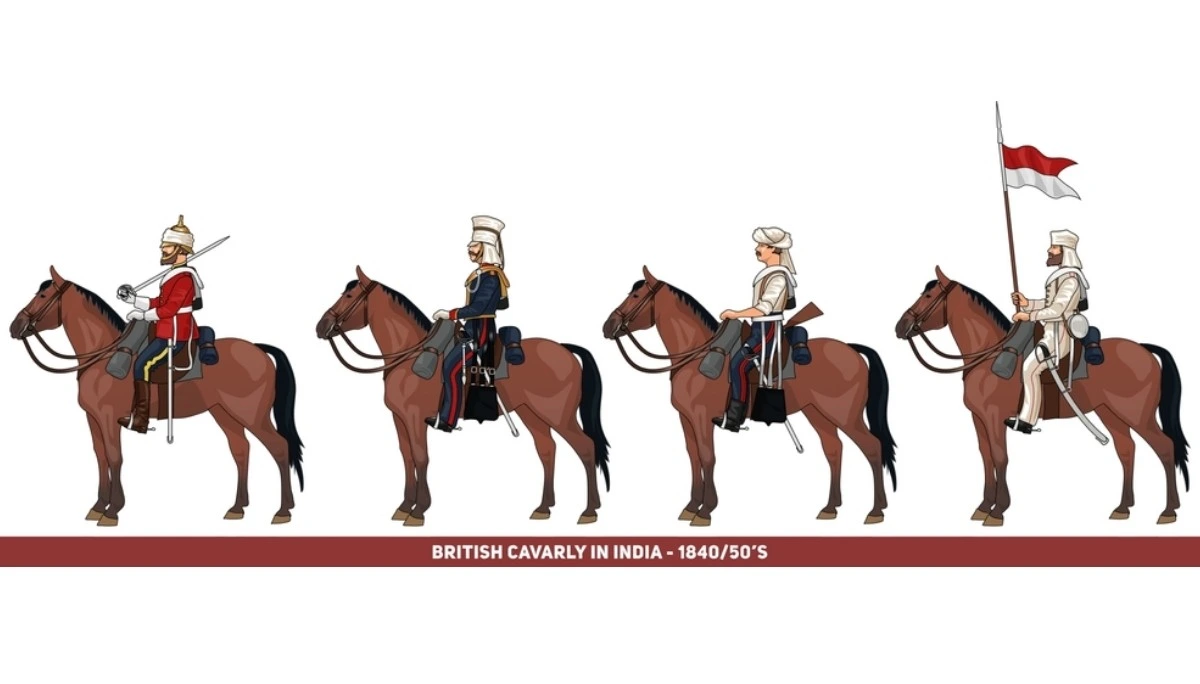
The arrival of Europeans in India marked a major turning point in the country’s history.
Beginning with the Portuguese in the late 15th century, followed by the Dutch, the French, and finally the British, India gradually came under foreign economic and political control.
While other powers established trading posts and limited influence, it was the British East India Company that ultimately gained dominance, leading to the establishment of the British Raj.
This colonial period not only reshaped India’s economy and politics but also influenced its society, education, and culture in lasting ways.
Advent of Europeans in India (1498–1757 CE)
European traders came to India mainly for the spice trade. Over time, they also aimed at political control.
Major European Powers:
- Portuguese – Vasco da Gama arrived at Calicut in 1498. First to establish trading posts. Important base: Goa (1510).
- Dutch – Came in early 17th century. Strong in spice islands, but declined in India after battles with British.
- British (East India Company) – Established in 1600. First factory at Surat (1612). Later spread to Bombay, Madras, and Calcutta.
- French (East India Company) – Founded in 1664. Bases at Pondicherry and Chandernagore.
Key Battles:
- Battle of Plassey (1757) – British defeated Siraj-ud-Daulah with help of Mir Jafar → beginning of British rule.
Table: European Powers
| Power | Year of Arrival | Key Centers in India | Key Events |
|---|---|---|---|
| Portuguese | 1498 (Vasco da Gama, Calicut) | Goa, Diu, Daman | Introduced tobacco, first Europeans in India. |
| Dutch | 1605 | Pulicat, Masulipatnam | Declined after defeat by British. |
| British | 1600 (EIC founded) | Surat, Bombay, Madras, Calcutta | Won Battle of Plassey (1757) → start of rule. |
| French | 1664 | Pondicherry, Chandernagore | Rivalry with British in Carnatic Wars. |
Key Facts:
- Portuguese → first to arrive, last to leave (1961 – Goa).
- Battle of Plassey (1757) → British victory over Siraj-ud-Daulah.
- French lost influence after Third Carnatic War (1763).
Colonial Period (1757–1857 CE)
This was the period of Company Rule in India.
Major Events:
- Battle of Buxar (1764) – British defeated Nawabs of Bengal, Awadh, and Mughal Emperor Shah Alam II → got Diwani rights (revenue collection) of Bengal, Bihar, Orissa.
- Expansion – British expanded through wars, alliances, and annexations.
- Mysore Wars – Fought against Hyder Ali and Tipu Sultan.
- Maratha Wars – Reduced Maratha power, British became dominant.
- Anglo-Sikh Wars – British annexed Punjab.
- Economic Impact – India turned into supplier of raw materials (cotton, indigo, jute) and consumer of British goods.
- Social Reform – Raja Ram Mohan Roy, Ishwar Chandra Vidyasagar worked for reform during this period.
End of Company Rule:
- Revolt of 1857 (First War of Independence) – Sepoy mutiny against British rule. Though unsuccessful, it marked the end of East India Company rule.
Table: Expansion of British Power
| War/Event | Year | Against | Outcome |
|---|---|---|---|
| Battle of Plassey | 1757 | Siraj-ud-Daulah (Bengal) | Mir Jafar installed, British dominance begins. |
| Battle of Buxar | 1764 | Bengal, Awadh, Mughal Emperor | British got Diwani rights (tax collection). |
| Anglo-Mysore Wars | 1767–1799 | Hyder Ali, Tipu Sultan | Tipu killed (1799). |
| Anglo-Maratha Wars | 1775–1818 | Marathas | Maratha power crushed. |
| Anglo-Sikh Wars | 1845–1849 | Sikh Empire | Punjab annexed. |
Key Facts:
- India became supplier of raw material.
- Permanent Settlement (1793) introduced by Cornwallis.
- Social reformers like Raja Ram Mohan Roy worked against Sati.
- Revolt of 1857 → End of Company Rule.
British Raj (1858–1947 CE)
After 1857, India came under direct rule of the British Crown. The Governor-General became the Viceroy of India.
Features of British Raj:
- Administration – Centralized system of governance. Indian Civil Services controlled by the British.
- Economic Policies – India became an economic colony; famines became frequent due to exploitation.
- Social & Cultural Changes – Western education introduced by Lord Macaulay; modern universities established.
- Freedom Struggle Begins –
- 1885: Formation of Indian National Congress (INC).
- Moderates & Extremists phase.
- Gandhian Movement – Non-Cooperation, Civil Disobedience, Quit India.
- Partition of Bengal (1905) – Sparked nationalist movement.
- World Wars – India contributed soldiers but demanded freedom in return.
End of British Raj:
- 1942 – Quit India Movement.
- 1947 – Independence & Partition → India and Pakistan created.
Table: Features of British Rule
| Aspect | Details |
|---|---|
| Administration | Governor-General → Viceroy (after 1858). ICS dominated by British. |
| Economy | Drain of wealth, famines, raw material exports. |
| Education | Macaulay’s Minute (1835), universities (1857). |
| Movements | 1885 INC founded; Gandhian movements; Quit India 1942. |
| End | Independence & Partition, 15 Aug 1947. |
Key Facts:
- 1858 → Queen’s Proclamation; India ruled by Crown.
- 1905 → Partition of Bengal by Lord Curzon.
- 1935 Government of India Act → basis for Constitution.
- 1942 Quit India Movement → “Do or Die”.
- Mountbatten Plan (1947) → India’s Independence & Partition.
… [Trackback]
[…] Find More Info here on that Topic: sarkariresultbook.com/european-colonial-period-british-raj/ […]
… [Trackback]
[…] Find More here on that Topic: sarkariresultbook.com/european-colonial-period-british-raj/ […]
… [Trackback]
[…] There you can find 68532 more Info to that Topic: sarkariresultbook.com/european-colonial-period-british-raj/ […]
… [Trackback]
[…] Read More to that Topic: sarkariresultbook.com/european-colonial-period-british-raj/ […]
… [Trackback]
[…] Read More here on that Topic: sarkariresultbook.com/european-colonial-period-british-raj/ […]
… [Trackback]
[…] Find More to that Topic: sarkariresultbook.com/european-colonial-period-british-raj/ […]
… [Trackback]
[…] There you can find 84820 additional Info to that Topic: sarkariresultbook.com/european-colonial-period-british-raj/ […]
… [Trackback]
[…] Info to that Topic: sarkariresultbook.com/european-colonial-period-british-raj/ […]
… [Trackback]
[…] Find More to that Topic: sarkariresultbook.com/european-colonial-period-british-raj/ […]
… [Trackback]
[…] Read More on that Topic: sarkariresultbook.com/european-colonial-period-british-raj/ […]
… [Trackback]
[…] Info to that Topic: sarkariresultbook.com/european-colonial-period-british-raj/ […]
… [Trackback]
[…] Read More Info here to that Topic: sarkariresultbook.com/european-colonial-period-british-raj/ […]
… [Trackback]
[…] Read More on on that Topic: sarkariresultbook.com/european-colonial-period-british-raj/ […]