

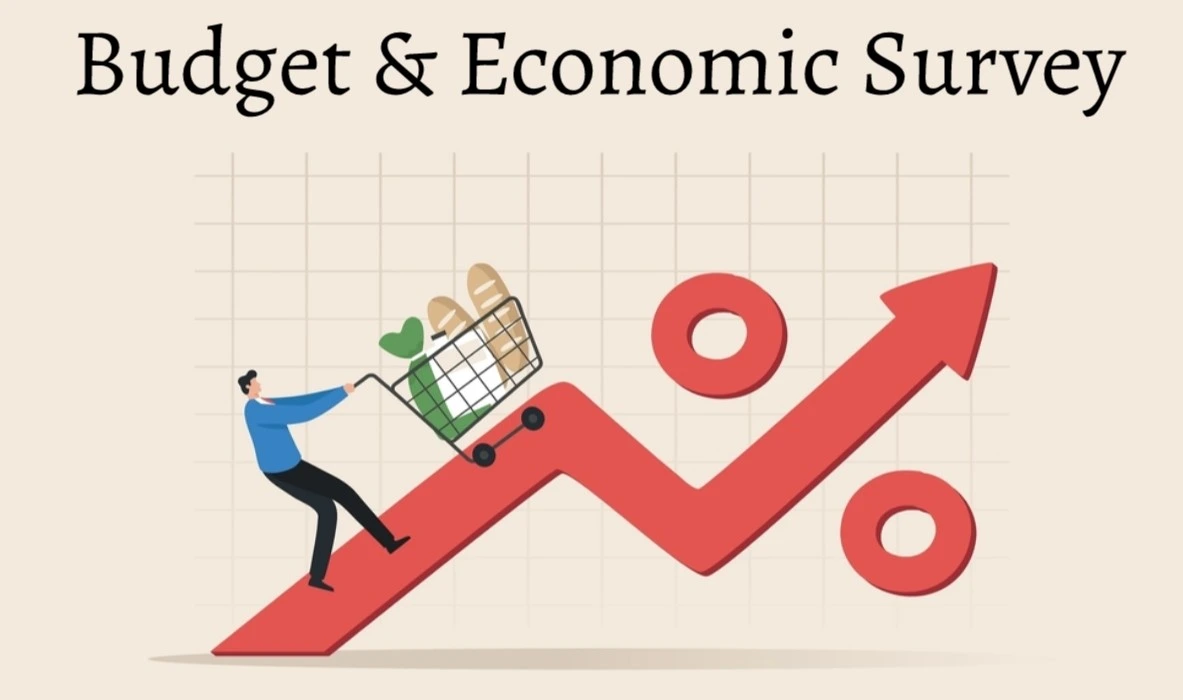
Every year, the Government of India presents two important documents – the Union Budget and the Economic Survey.
These are very important for understanding the country’s economy.
Moreover they are also a key topic in Static GK and Current Affairs for competitive exams like SSC, Banking, UPSC, and State PSCs.
What is the Union Budget?
The Union Budget is the government’s yearly financial statement. It tells us:
- How much money the government plans to earn (Revenue)
- How much it will spend (Expenditure)
- Which sectors will get more focus (like health, education, defense, etc.)
It is presented by the Finance Minister in Parliament, usually on 1st February every year.
Key Parts of Budget
- Revenue Budget
- Income from taxes (Income Tax, GST, Customs duty, etc.)
- Non-tax income (dividends, fees, etc.)
- Capital Budget
- Loans raised by the government
- Expenses on building assets like roads, railways, schools, hospitals
What is the Economic Survey?
- The Economic Survey is a report prepared by the Ministry of Finance.
- It is presented a day before the Budget in Parliament.
- It gives a review of the economy for the past year and sets the expectations for the coming year.
Why is it important?
- Shows the GDP growth rate
- Reviews key sectors: agriculture, industries, services
- Highlights government policies and reforms
- Helps the Finance Minister prepare the Budget
Difference Between Budget & Economic Survey
| Aspect | Economic Survey | Union Budget |
|---|---|---|
| Purpose | Reviews the economy of the previous year | Plans the income & spending for the next year |
| Who Prepares | Chief Economic Adviser (Finance Ministry) | Ministry of Finance |
| When Released | A day before the Union Budget | 1st February every year |
| Nature | Analytical (facts & suggestions) | Action-oriented (actual financial plan) |
Why Students & Aspirants Should Study It?
- Helps understand India’s economy in simple terms.
- Questions often come in exams (e.g., “Who presents the Budget?”, “What is Revenue Deficit?”, “Which document is released before the Budget?”).
- Useful for essay writing, interviews, and GDs.
Quick Facts for Exams
- First Budget of Independent India was presented in 1947 by R.K. Shanmukham Chetty.
- Budget is presented every year on 1st February.
- Economic Survey is prepared under the guidance of the Chief Economic Adviser (CEA).
- Revenue Deficit = Revenue Expenditure – Revenue Receipts.
- Fiscal Deficit = Total Expenditure – (Revenue Receipts + Non-Debt Capital Receipts).
Important Budget Terms
Here’s a list of all important budget terms explained in very simple words. These are extremely useful for SSC, Banking, UPSC, and other competitive exams.
1. Revenue Receipts
- Money the government earns without borrowing.
- Includes tax income (Income Tax, GST, Corporate Tax, Customs duty) and non-tax income (dividends from PSUs, interest, fines, fees).
2. Revenue Expenditure
- Day-to-day expenses of the government.
- Includes salaries, pensions, subsidies, interest payments.
- Does not create assets.
3. Capital Receipts
- Money the government earns through borrowing or disinvestment.
- Examples: Loans from RBI/World Bank, selling shares of government companies.
4. Capital Expenditure
- Spending that creates assets or reduces liabilities.
- Examples: Building roads, schools, railways, hospitals, repaying loans.
5. Fiscal Deficit
- The gap between total expenditure and total receipts (excluding borrowings).
- Formula:
Fiscal Deficit = Total Expenditure – (Revenue Receipts + Non-Debt Capital Receipts) - Shows how much the government needs to borrow.
6. Revenue Deficit
- When Revenue Expenditure > Revenue Receipts.
- Means government is spending more on day-to-day needs than it is earning.
7. Primary Deficit
- Fiscal Deficit minus interest payments.
- Shows government’s borrowing excluding past loan interest.
8. Effective Revenue Deficit
- Revenue Deficit minus grants given to states for asset creation.
- Introduced to highlight money spent on productive use.
9. Plan & Non-Plan Expenditure (earlier used, now discontinued)
- Plan Expenditure: For development programs (education, health, rural schemes).
- Non-Plan Expenditure: Salaries, subsidies, defense, pensions.
(Now replaced by Capital & Revenue classification)
10. Budget Deficit
- When total expenditure > total receipts (very broad term, now less used).
11. Monetized Deficit
- Part of the Fiscal Deficit financed by the RBI (by printing more money).
12. Disinvestment
- Selling government’s stake in public sector companies (like LIC, ONGC).
- Helps raise funds and reduce fiscal deficit.
13. Consolidated Fund of India
- Main account of the government.
- All revenues, loans, and money received go into this fund.
14. Contingency Fund of India
- Emergency fund kept at the President’s disposal.
- Used for urgent and unforeseen expenses.
15. Public Account of India
- Fund for money held by government on behalf of others.
- Example: Provident Fund, Small Savings, Postal deposits.
16. Zero-Based Budgeting (ZBB)
- Every department has to justify its budget from zero every year.
- Unlike traditional budgeting where last year’s numbers are just adjusted.
17. Outcome Budget
- Measures results/impact of government spending, not just the money spent.
Quick Exam Revision Pointers
- Fiscal Deficit = Total Borrowing Needed
- Revenue Deficit = Income < Daily Expenses
- Primary Deficit = Fiscal Deficit – Interest Payments
- Disinvestment = Selling government’s share in PSUs
- Funds of India = Consolidated Fund, Contingency Fund, Public Account
… [Trackback]
[…] Find More Information here on that Topic: sarkariresultbook.com/budget-economic-survey-basics/ […]
… [Trackback]
[…] Info on that Topic: sarkariresultbook.com/budget-economic-survey-basics/ […]
… [Trackback]
[…] Info to that Topic: sarkariresultbook.com/budget-economic-survey-basics/ […]
… [Trackback]
[…] There you will find 51607 more Information to that Topic: sarkariresultbook.com/budget-economic-survey-basics/ […]