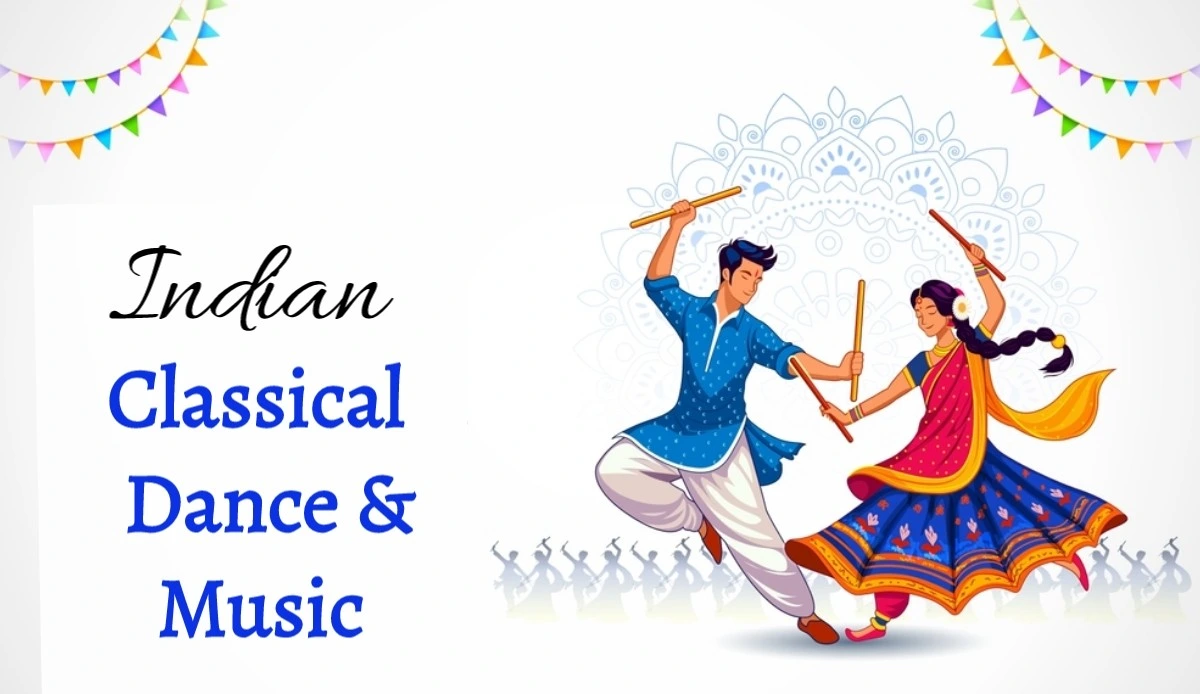
India has a very old and rich tradition of art, dance, and music. These forms are not only a source of entertainment but also a reflection of India’s culture, history, and spirituality.
Classical dance and music in India are deeply connected to religion, mythology, and temple traditions.
In this article we will discuss in details about, Indian Classical Dances and Music accompanied by related facts and informations.
Indian Classical Dances
India has 8 classical dance forms, officially recognized by the Sangeet Natak Akademi. Each dance comes from a specific region and has unique style, costume, and music.
| Dance Form | State | Key Features |
|---|---|---|
| Bharatanatyam | Tamil Nadu | Oldest dance; temple dance; strong footwork and hand gestures; dedicated to Lord Shiva. |
| Kathak | Uttar Pradesh | Storytelling dance; fast spins and footwork; influenced by Mughal courts. |
| Kathakali | Kerala | Dance-drama; colorful makeup; stories from Mahabharata and Ramayana. |
| Kuchipudi | Andhra Pradesh | Dance + drama; graceful movements; performed with speech and songs. |
| Odissi | Odisha | Temple dance; body bends; sculpturesque poses; dedicated to Lord Jagannath. |
| Manipuri | Manipur | Soft, graceful dance; based on Krishna-Radha stories. |
| Mohiniyattam | Kerala | Feminine, slow, and graceful; performed by women. |
| Sattriya | Assam | Created by Srimanta Sankardev; performed in monasteries by monks. |
Indian Classical Music
Indian classical music has two main styles:
- Hindustani Music (North India)
- Developed mainly in North India after the 13th century.
- Influenced by Persian/Mughal styles.
- Instruments: Sitar, Tabla, Sarod, Shehnai, Santoor.
- Famous artists: Pandit Ravi Shankar, Ustad Bismillah Khan, Zakir Hussain.
- Carnatic Music (South India)
- Originated in South Indian temples.
- Pure form with minimal outside influence.
- Instruments: Veena, Mridangam, Violin, Flute.
- Famous artists: M.S. Subbulakshmi, Tyagaraja, Muthuswami Dikshitar, Shyama Shastri.
Important Terms:
- Raga: Set of musical notes used to create a mood.
- Tala: Rhythm or beat pattern.
- Abhinaya: Expression in dance (facial and hand gestures).
- Natya Shastra: Ancient Sanskrit text; foundation of Indian dance & music.
History & Origins
- Roots in temple rituals dating back 2000–3000 years.
- Natya Shastra by Bharata Muni (200 BCE – 200 CE) guides dance, music, and drama.
- Dance and music were used to tell religious stories and educate people.
Festivals & Awards
- Khajuraho Dance Festival (MP): Showcases Kathak, Odissi, Bharatanatyam.
- Konark Dance Festival (Odisha): Focus on Odissi at Sun Temple.
- Sangeet Natak Akademi Awards: National recognition for excellence in arts.
- Classical music is performed in temples, weddings, and festivals.
Famous Instruments
- Sitar, Veena, Sarod, Santoor, Tabla, Mridangam, Flute, Shehnai, Harmonium
- Each dance has its traditional instruments (e.g., Bharatanatyam with Mridangam; Kathak with Tabla).
Notable Artists
- Bharatanatyam: Rukmini Devi Arundale
- Kathak: Birju Maharaj
- Odissi: Kelucharan Mohapatra
- Carnatic Music: M.S. Subbulakshmi
- Hindustani Music: Ravi Shankar, Bhimsen Joshi
Interesting Facts
- Bharatanatyam = “Dance of the Temple”.
- Kathak = “storyteller” in Sanskrit.
- Sattriya was performed only by monks before 2000.
- Indian classical music uses Ragas to evoke emotions.
- Classical dances are considered living art forms taught from childhood.
Key Facts to Remember (Quick Revision)
- 8 classical dance forms recognized by Sangeet Natak Akademi.
- Natya Shastra = oldest book on performing arts.
- Hindustani & Carnatic = two main classical music styles.
- Bharatanatyam = oldest dance form; Sattriya = newest recognized.
- Famous artists: Ravi Shankar (Sitar), M.S. Subbulakshmi (Carnatic), Birju Maharaj (Kathak).
- Major festivals: Khajuraho, Konark.
… [Trackback]
[…] Read More to that Topic: sarkariresultbook.com/indian-classical-dances-music/ […]
… [Trackback]
[…] Read More on to that Topic: sarkariresultbook.com/indian-classical-dances-music/ […]
… [Trackback]
[…] Here you can find 75438 additional Information to that Topic: sarkariresultbook.com/indian-classical-dances-music/ […]
… [Trackback]
[…] Here you can find 70408 more Information on that Topic: sarkariresultbook.com/indian-classical-dances-music/ […]
… [Trackback]
[…] Here you can find 51932 additional Info to that Topic: sarkariresultbook.com/indian-classical-dances-music/ […]